Fiber Optic Installation & Emergency Fiber Repair Atlanta | Nationwide Commercial Fiber Contractor | TechDispatch360
DISPATCH ONLINE · NATIONWIDE
COMMERCIAL FIBER OPTIC CONTRACTOR · NO RESIDENTIAL Dispatch Live · Fiber Crews Accepting Requests Now

Fiber Optic Installation & Emergency Fiber Repair.

Commercial fiber optic installation, fusion splicing, OTDR testing, fiber backbone deployment, and emergency fiber repair throughout Atlanta, Georgia, the Southeast, and nationwide. Enterprise fiber infrastructure for offices, warehouses, manufacturing, healthcare, data centers, ISPs, and multi-site operators.

24/7 Fiber Dispatch · Request a Site Survey · Nationwide 770-441-9999
Nationwide Support Emergency Response OTDR Certified Fusion Splicing Atlanta · 27+ Years
Commercial fiber optic infrastructure with glowing fiber strands, fusion splicing and enterprise data center patch panels
TechDispatch360 is operated by DataTel 360, Atlanta, Georgia. Commercial fiber optic, structured cabling, VoIP, and smart hands experience since 1998. TRUSTED SINCE 1998
24/7/365Fiber Dispatch
All 50 StatesNationwide Fiber
Fusion SplicingSingle & Ribbon
OTDR CertifiedTested & Reported
Closeout ReportsEvery Fiber Run
Emergency RepairFiber Outages
COMMERCIAL FIBER OPTIC SERVICES

Ten core fiber optic services. One enterprise operations team.

Full-spectrum commercial fiber optic cabling, fusion splicing, OTDR testing, fiber backbone deployment, and emergency repair — for commercial environments across Atlanta and all 50 states. Every project documented, tested, and certified.

FIBER OPTIC OPERATIONAL STANDARDS BICSI-TRAINED FIBER TECHS ANSI/TIA-568 · 606 · 607 OTDR + FLUKE CERTIFIED FUSION SPLICING WRITTEN CLOSEOUT REPORTS
EMERGENCY FIBER REPAIR · 24/7/365

Fiber down? Cable cut? We dispatch fast.

A severed fiber trunk shuts down a commercial site in seconds. Every minute is measurable revenue loss and broken SLAs. Our Atlanta-based emergency fiber dispatch operates 24/7/365 — metro Atlanta and all 50 states — with no after-hours surcharges.

Call 770-441-9999. A live operator engages immediately, confirms site, fiber type, and symptoms, then routes the nearest fiber technician with the right OTDR, fusion splicer, splice enclosures, and outdoor-rated repair components.

  • Fiber outages & cable cuts — total loss-of-light, attenuation creep, construction strikes, forklift damage
  • Damaged trunks & enclosures — water intrusion, rodent damage, UV-degraded cable, crushed conduit
  • OTDR break location & restoration — in-line splice repair, replacement runs, full re-certification
  • ISP coordination — carrier-side handoff troubleshooting, demarc extensions, joint repair
  • Temporary continuity — pre-terminated emergency runs and aerial drops while the permanent repair is scoped
  • After-hours support — nights, weekends, holidays — same dispatch, same standards, no markup
24/7/365 FIBER EMERGENCY LINE

Outage in progress?

Skip the form. Call dispatch directly — a live operator engages and we route a fiber tech immediately.

770-441-9999
DIRECT · LIVE · NO QUEUE
24/7
Live Dispatch
365
Days A Year
50
States Served
2-4 hr
Metro ATL Dispatch
FIBER DOWN?
Rapid dispatch available now. Live operators answer 24/7/365 — no answering service, no queue, no after-hours surcharge.
770-441-9999
COMMON COMMERCIAL FIBER EMERGENCIES

The outages and failures we're dispatched for most.

Commercial fiber fails when backhoes hit conduit, boring crews strike duct banks, splice enclosures take on water, or aerial spans get torn down. These are the incidents our metro Atlanta and nationwide fiber emergency teams respond to most.

EM · 01

Construction cable cuts

Backhoes, trenchers, and grading crews striking active fiber. Restoration, splice, re-certification.

EM · 02

Damaged underground fiber

Buried fiber crushed by settling, traffic loads, or third-party trenching. OTDR location, vault access, re-splice.

EM · 03

Aerial fiber damage

Down spans from vehicle strikes, wind, fallen limbs, or pole work. Temporary drops and permanent re-attachment.

EM · 04

Damaged splice enclosures

Compromised closures from water, UV, or rodents. Replacement, full re-splice, bidirectional OTDR verification.

EM · 05

Failed ISP handoffs

Demarc failures, dirty SMF connectors, mismatched optics. Joint troubleshooting with the ISP until handoff is clean.

EM · 06

Backbone outages

Risers, inter-building runs, and campus backbones down. Trace, isolate, splice or replace, certify.

EM · 07

Water intrusion damage

Flooded vaults, water in conduit, saturated trays. Drying, cleaning, strand-by-strand splice verification.

EM · 08

Damaged conduit & duct bank

Crushed inner-duct, collapsed conduit, compromised duct banks. Repair, re-pull where required, end-to-end re-test.

EM · 09

Directional boring strikes

HDD crews hitting unmarked or mis-marked fiber. Emergency dispatch, OTDR fault location, certified turn-up.

FUSION SPLICING & FIBER TERMINATION

Clean fusion splicing. Documented to spec.

A fiber network is only as good as its splices. We provide commercial fusion splicing for new installations, repairs, ISP handoffs, and patch panel terminations — every splice measured, every result documented.

Our splice technicians work to professional testing standards: low insertion loss, clean end-face prep, proper sleeve protection, and labeled trays. Every splice is bidirectionally measured against the loss budget and recorded in the closeout package.

Whether it's a few terminations into a 24-port panel or a 288-strand backbone splice in a vault, the methodology is the same: prepare, cleave, splice, test, document.

Fusion splicing & termination services

  • Single-fiber fusion splicing — repairs, pigtails, patch terminations, tray organization
  • Ribbon splicing — high-fiber-count backbones, mass-fusion for data center and ISP scopes
  • Patch panel termination — LC, SC, ST, MPO/MTP — labeled and routed cleanly inside the panel
  • Enclosure organization — outdoor splice closures, wall-mounts, rack-mount enclosures, proper bend radius
  • Loss reduction — bidirectional OTDR validation, splice rework if loss exceeds spec
  • Clean documentation — splice logs, loss measurements, port-to-port maps, photo records
Enterprise network rack with fiber optic patch panels, fusion splice trays, and labeled cable management
Live Fiber Dispatch · Nationwide Coverage Available

Need fiber installed, spliced, or repaired? Open a ticket in 60 seconds.

Single splice, full fiber backbone, building-to-building project, or emergency outage — one dispatch, one fiber-trained project manager.

OTDR TESTING & FIBER DIAGNOSTICS

OTDR testing, signal-loss diagnostics, and full certification reporting.

Every commercial fiber run we install or repair is OTDR-tested, optical-power-meter validated, and certified in writing — from 24-strand metro Atlanta backbones to 288-strand nationwide campus builds. Customers receive a full fiber health report at closeout.

Data center fiber optic infrastructure with high-density patch fields and rack-mounted enclosures used for OTDR fiber testing

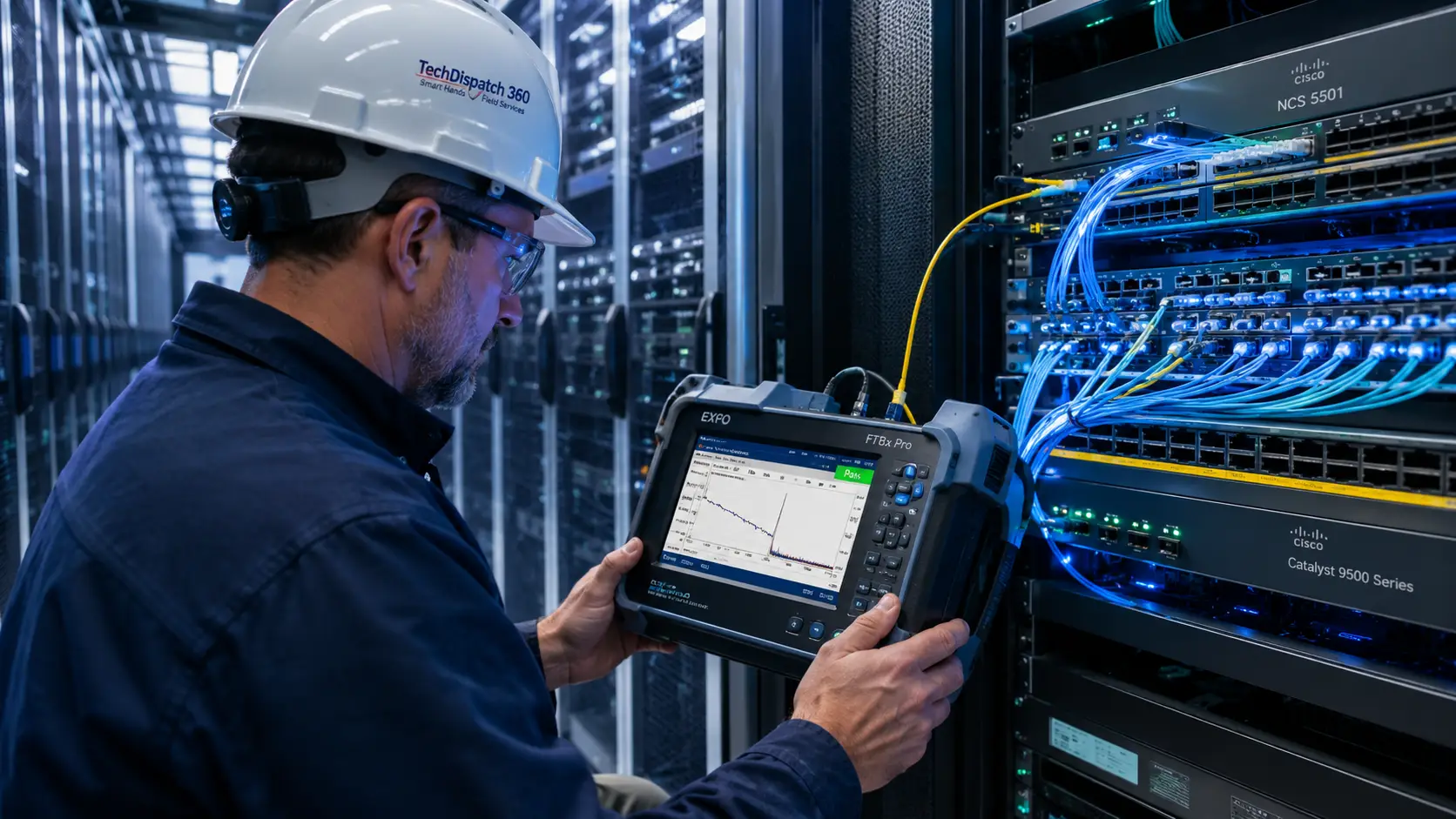
An OTDR (Optical Time Domain Reflectometer) injects a calibrated light pulse into a fiber strand and measures the reflected and backscattered light — producing an event map of every splice, connector, bend, and break down to the meter.

We use OTDR data to certify new installations to TIA standards, pinpoint break locations during outage response, troubleshoot intermittent failures, and document fiber health for the customer record.

Standards & equipment

  • Fluke optical testing — Fluke DSX, OptiFiber Pro, FI-7000 fiber inspection
  • OTDR analysis — multi-pulse-width traces for short patch and long-haul runs
  • Certification reports — PDF + native trace format for archival
FIBER TESTING & CERTIFICATION SCOPE

What enterprise-grade fiber certification actually looks like.

Anyone can run a power meter and call a link "good." Commercial-grade certification means bidirectional OTDR traces, documented loss budgets, strand-level reports, and acceptance documentation that holds up under audit. Below is the testing and certification scope delivered on every project.

TEST · 01

OTDR testing

Bidirectional traces with multi-pulse-width capture for patch fields, risers, and long-haul OS2 backbones.

TEST · 02

Insertion loss testing

End-to-end power meter testing against the calculated optical loss budget. Pass/fail recorded per strand.

TEST · 03

Reflectance testing

Connector and event reflectance measured to catch dirty end-faces, dry connections, and high-loss mating sleeves.

TEST · 04

TIA-568 fiber certification

Full compliance report — every strand, both directions, complete event map. Delivered as PDF + native trace.

TEST · 05

Signal loss diagnostics

Attenuation creep, macro-bends, dirty connectors, mismatched fiber, and bad splices isolated to specific events.

TEST · 06

Intermittent fault troubleshooting

Flapping links, marginal budgets, and temperature-sensitive faults isolated with OTDR + environmental review.

TEST · 07

Break location

OTDR pulse analysis pinpoints break location to the meter, underground or across long campus runs.

TEST · 08

Acceptance testing

Every commercial install runs the full test sweep, reviewed and signed off before turnover. No exceptions.

TEST · 09

Turnover documentation

Closeout package: test results, event maps, splice logs, port labels, rack elevations, as-builts. Audit-ready.

CLOSEOUT DELIVERABLES
OTDR TRACES LOSS REPORTS EVENT MAPS SPLICE LOGS PORT LABELS AS-BUILT DRAWINGS PASS/FAIL CERTIFICATION
SINGLEMODE VS MULTIMODE FIBER

Choosing the right fiber. Singlemode vs multimode, explained.

Most commercial environments use both: singlemode (OS2) for long-distance backbone, ISP handoffs, and carrier infrastructure — multimode (OM3/OM4/OM5) for in-building LAN and MDF/IDF interconnects. Here's how they compare at a practical, deployment-ready level.

SINGLEMODE FIBER · OS2

Long-distance & carrier-grade

A single light path through a 9-micron core. Engineered for distance — campus backbones, building-to-building runs, ISP and carrier connections, and runs that need to scale beyond gigabit speeds for years to come.

  • ISP handoffs — the standard for carrier and last-mile fiber delivery
  • Long-distance backbone — typically 10 km+, 40 km routinely supported
  • Carrier infrastructure — telecom, ISP, MSP, and POP buildouts
  • Campus connectivity — inter-building risers and outside-plant runs
Use when: distance > 300m, ISP handoff, future-proofing for high-throughput
MULTIMODE FIBER · OM3 / OM4 / OM5

In-building LAN & data center

Multiple light paths through a 50-micron core. Optimized for shorter runs — building LANs, MDF-to-IDF interconnects, and high-density data center patch fields where cost-effective high throughput over modest distance is the goal.

  • MDF/IDF interconnects — main-frame to intermediate distribution rooms
  • LAN infrastructure — enterprise switch-to-switch and switch-to-server
  • Enterprise building environments — converged voice, data, AV, security
  • Shorter runs — typically up to 300–400m depending on OM grade
Use when: distance < 300m, high port density, in-building only

Fiber distance & throughput reference

Fiber TypeCore / ModeTypical SpeedMax DistanceTypical Commercial Use
OM3 Multimode50µm / multi10 Gbps300 m (10G)Standard enterprise LAN, MDF-IDF runs
OM4 Multimode50µm / multi40–100 Gbps150 m / 100 mData center backbones, high-density runs
OM5 Multimode50µm / multi100 Gbps+150 m+Future-proof enterprise & data center
OS2 Singlemode9µm / single100+ Gbps40+ kmCampus backbones, ISP handoff, long-haul
BUILDING-TO-BUILDING FIBER

Campus, industrial, and inter-building fiber, delivered as one project.

Connecting two or more buildings on the same site is one of the most common — and most under-scoped — fiber projects. We design and deploy building-to-building fiber for corporate campuses, office parks, warehouses, distribution centers, manufacturing, healthcare, schools, and multi-tenant commercial properties.

Building-to-building fiber optic infrastructure with glowing fiber strands and outdoor-rated singlemode cable for campus deployment

A clean inter-building run requires more than pulling cable. The right cable type, path, and termination strategy determines whether the link runs for 20 years quietly — or starts attenuating, leaking water, or flapping within months.

Inter-building fiber scopes

  • Underground conduit — armored singlemode in PVC or HDPE, properly buried and capped
  • Aerial fiber — pole-to-pole, building-to-pole, rooftop runs with appropriate strand & lashing
  • Campus & warehouse runs — multi-building corporate, education, healthcare, government, distribution sites
  • Industrial & logistics — manufacturing, food processing, cold storage — hardened outdoor cable
  • Office parks & remote IDFs — tenant-to-tenant paths, back-of-house IDF expansion off inter-building backbone

Pathway coordination

  • Trenching & directional boring — civil partner sequencing for new conduit, vaults, sidewalk and driveway crossings
  • Conduit pathways — sizing, sweeps, pull strings for current and future runs
  • Demarc extensions — extending the carrier demarc to a second building or remote IDF
MDF / IDF FIBER BACKBONE INFRASTRUCTURE

Enterprise MDF and IDF fiber backbones, designed before they're installed.

The MDF and its IDFs form the spine of the commercial network. DataTel 360 produces the engineering drawings, port plans, and backbone scope; TechDispatch360 delivers the install.

Enterprise MDF room with fiber optic backbone, rack-mounted fiber enclosures, and labeled patch panels for commercial network infrastructure

Done right, an MDF is a clean, labeled, expandable environment that serves a building for 15+ years with minor MAC work. Done wrong, it becomes a constant source of outages, mis-patched ports, and panic during the next upgrade. We approach every buildout as infrastructure that will outlast the leadership team that authorized it.

MDF & IDF fiber backbone deliverables

  • Backbone design — fiber count, strand assignment, port mapping, 3-year growth capacity
  • Vertical risers — properly sleeved fiber risers between floors, plenum where required
  • Fiber distribution — high-density LIU panels, MPO/MTP cassettes, breakout modules
  • Patch & cable management — labeled, color-coded, mapped to as-builts, vertical & horizontal managers
  • Rack integration — relay racks, two-post and four-post cabinets, TIA-607 grounding
  • Labeling, docs & scalability — TIA-606 labels, as-builts, photo records, spare positions, pull strings
Live Dispatch · Enterprise Fiber Available

Planning an MDF buildout or campus backbone? Let's scope it.

Site survey, fiber count planning, port mapping, and a fixed-price installation quote — typically within one business day.

COMMERCIAL ENVIRONMENTS SERVED

Commercial fiber for ten core industries. No residential.

TechDispatch360 supports commercial fiber across the full enterprise spectrum — from single-location small businesses to multi-site national operators.

Also supporting: ISPs, MSPs, telecom providers, logistics, financial services, and multi-site enterprise operators.

WHY TECHDISPATCH360

Built for commercial fiber optic infrastructure that has to work — and stay working.

A division of DataTel 360, Atlanta-based since 1998. Engineering at DataTel 360. Field deployment, fusion splicing, OTDR, and emergency response through TechDispatch360. Same operations team. One escalation path.

27+ years of field experience

Founded in 1998 as DataTel 360. Nearly three decades of structured cabling, fiber, and enterprise telecom field deployment.

Atlanta HQ · nationwide dispatch

Local crews for metro Atlanta and the Southeast. Dispatched fiber technicians across all 50 states, single PM on multi-site rollouts.

BICSI-trained fiber technicians

Hands-on experience in fusion splicing, OTDR, ISP handoff, and emergency restoration — not generalists with a fiber tool.

24/7/365 emergency response

Live dispatch, no after-hours surprise markup. One number — 770-441-9999 — for every fiber outage.

Testing & certification standard

Every install delivered with OTDR traces, power-meter results, port maps, and a written certification report. Audit-ready.

Commercial-only · SMB → enterprise

No residential service. One small business with one fiber link, or a national multi-site program — same standards, same team.

BACKED BY DATATEL 360

27+ years of commercial fiber optic work behind every install.

Operated by DataTel 360 — Atlanta-based since 1998. Engineering, design, and field deployment under one roof. Single splice repair or multi-site enterprise rollout — same operations team.

READ THE TECHDISPATCH360 STORY
27+
YEARS IN BUSINESS
50
STATES SERVED
24/7
FIBER DISPATCH
SMB→
ENT
CLIENT RANGE
FIBER OPTIC COVERAGE

Atlanta-based fiber crews. Nationwide dispatch.

Local crews in Atlanta and the Southeast. Dispatched fiber technicians across all 50 states for multi-site programs, emergency restoration, and one-time projects.

ATLANTA HQ
Charlotte
Nashville
Birmingham
Orlando
Tampa
Miami
Jacksonville
Dallas
Houston
Chicago
New York
Don't see your city? We dispatch fiber technicians nationwide. View full coverage map or open a request with your address and we'll confirm coverage within minutes.
FREQUENTLY ASKED QUESTIONS

Commercial fiber optic FAQs.

The questions we hear most often when scoping a fiber installation, splice, OTDR test, or emergency repair. Don't see your question? Open a ticket or call 770-441-9999.

For commercial fiber emergencies in metro Atlanta, we typically dispatch a fiber technician within 2 to 4 hours, 24/7/365. Nationwide emergency dispatch is generally same-day or next-day depending on site location, fiber type, splice complexity, and ISP coordination requirements. Call 770-441-9999 the moment a fiber outage is detected so we can begin OTDR-based break location, coordinate ISP handoff, and route the closest available fiber crew to the site.

OTDR (Optical Time Domain Reflectometer) testing is the industry standard method for measuring the health, length, attenuation, and exact break location of a fiber optic cable. The OTDR injects a calibrated light pulse into the fiber and measures the reflected and backscattered light to map every event along the run — splices, connectors, bends, and breaks. We use OTDR testing to certify newly installed fiber to manufacturer and TIA standards, to pinpoint outage locations down to the meter, and to produce written test reports for clients at project closeout.

Singlemode fiber (OS2) carries a single light path through a very thin 9-micron core and is engineered for long-distance transmission — campus backbones, building-to-building, carrier-grade ISP handoffs, and runs measured in kilometers. Multimode fiber (OM3, OM4, OM5) uses a larger 50-micron core and is optimized for shorter runs inside buildings and data centers, typically up to a few hundred meters depending on grade and speed. Most enterprise environments use both: singlemode for backbones and inter-building, multimode for in-building LAN and data center interconnects.

Yes. Fusion splicing is a core service. Our technicians perform single-fiber fusion splicing and ribbon fusion splicing for new installations, repair work, pigtail termination, splice enclosures, and patch panel termination. Every splice is measured for insertion loss and documented in the closeout report.

Yes. We routinely coordinate with internet service providers and carriers to receive fiber handoffs at the demarc, terminate the carrier fiber into the client's MDF, install the appropriate patch panel and cross-connect, and validate the circuit. We can act as the onsite smart hands for the carrier during turn-up and testing.

Yes. We respond to underground fiber damage from construction strikes, accidental cable cuts, water intrusion, and rodent damage. We perform OTDR-based break location, expose the damaged section, splice in repair sections using outdoor-rated splice enclosures, re-test, and document. For larger trenching, boring, or conduit replacement scopes, we coordinate licensed civil partners while remaining the single point of contact.

Yes. TechDispatch360 is headquartered in Atlanta and dispatches commercial fiber installation, splicing, and emergency repair across all 50 states. Multi-site rollouts get a single dedicated project manager, consolidated reporting, standardized labeling, and one escalation path for the customer.

Yes. Building-to-building fiber is one of our core scopes. We install singlemode and outdoor-rated multimode fiber across campuses, office parks, industrial sites, warehouses, and multi-tenant properties using underground conduit, directional boring, or aerial paths. Every inter-building run is OTDR-tested and certified at handoff.

Yes. Every fiber installation includes OTDR testing, optical power meter testing, end-face inspection, and a written certification report covering attenuation, loss budget, length, and event map for each strand. Test results are delivered to the customer at project closeout for warranty and asset records.

Yes. Our Atlanta-based fiber crews work across metro Atlanta and Georgia, including Sandy Springs, Alpharetta, Roswell, Marietta, Smyrna, Norcross, Duluth, Lawrenceville, Decatur, Buckhead, Midtown, downtown Atlanta, College Park, Kennesaw, and Cumberland — plus business corridors in Cobb, Fulton, DeKalb, Gwinnett, Cherokee, and Forsyth counties. Metro Atlanta projects are typically scoped and dispatched within hours; statewide Georgia projects are coordinated from the same operations team.

We support commercial offices, office parks, warehouses, distribution centers, logistics facilities, manufacturing plants, industrial campuses, retail locations and chains, healthcare facilities, schools and universities, government sites, hospitality properties, multi-tenant buildings, data centers, ISPs, MSPs, and multi-site enterprise customers. All work is commercial only — no residential service, no marketplace freelancers.

A full fiber optic certification report from TechDispatch360 includes bidirectional OTDR traces for every strand, optical power meter loss measurements against the calculated loss budget, connector reflectance, end-face inspection notes, event maps with break/splice locations, pass/fail status per strand, port-to-port labeling, splice loss logs, and as-built drawings where applicable. Reports are delivered as PDF plus native OTDR trace files so they can be re-loaded into any standards-compliant analysis tool for future audits or troubleshooting.

REQUEST FIBER OPTIC SUPPORT

Ready to scope your fiber project?

Single-strand splice repair, full MDF/IDF backbone buildout, campus link, or 24/7 emergency restoration. Fixed-price quote, typically within one business day.

CALL FIBER DISPATCH · 24/7/365
770-441-9999
What happens after you submit:
Reply within 1 business hour, often faster
Emergency fiber calls routed direct to a dispatcher
Fixed-price quote with tech profile & site ETA
OTDR-tested, certified, documented closeout

Submit your fiber support request on our homepage

All fiber installation, splicing, OTDR testing, and emergency repair requests are submitted through the unified support form on the TechDispatch360 homepage. Open the form, or call dispatch directly.

For active outages, do not wait on the form. Call dispatch directly — a live operator engages and we route a fiber technician immediately.

Direct line: 770-441-9999 · Email: support@techdispatch360.com
Field technician program: techdispatch360.com/join-network

Fiber down? Cable cut? Trunk severed?

24/7/365 emergency fiber optic dispatch — rapid commercial restoration across all 50 states.

📞 770-441-9999 EMERGENCY PAGE →

You cannot copy content of this page